Xavier Remington
 🛸 The Forgotten Civilization Theory
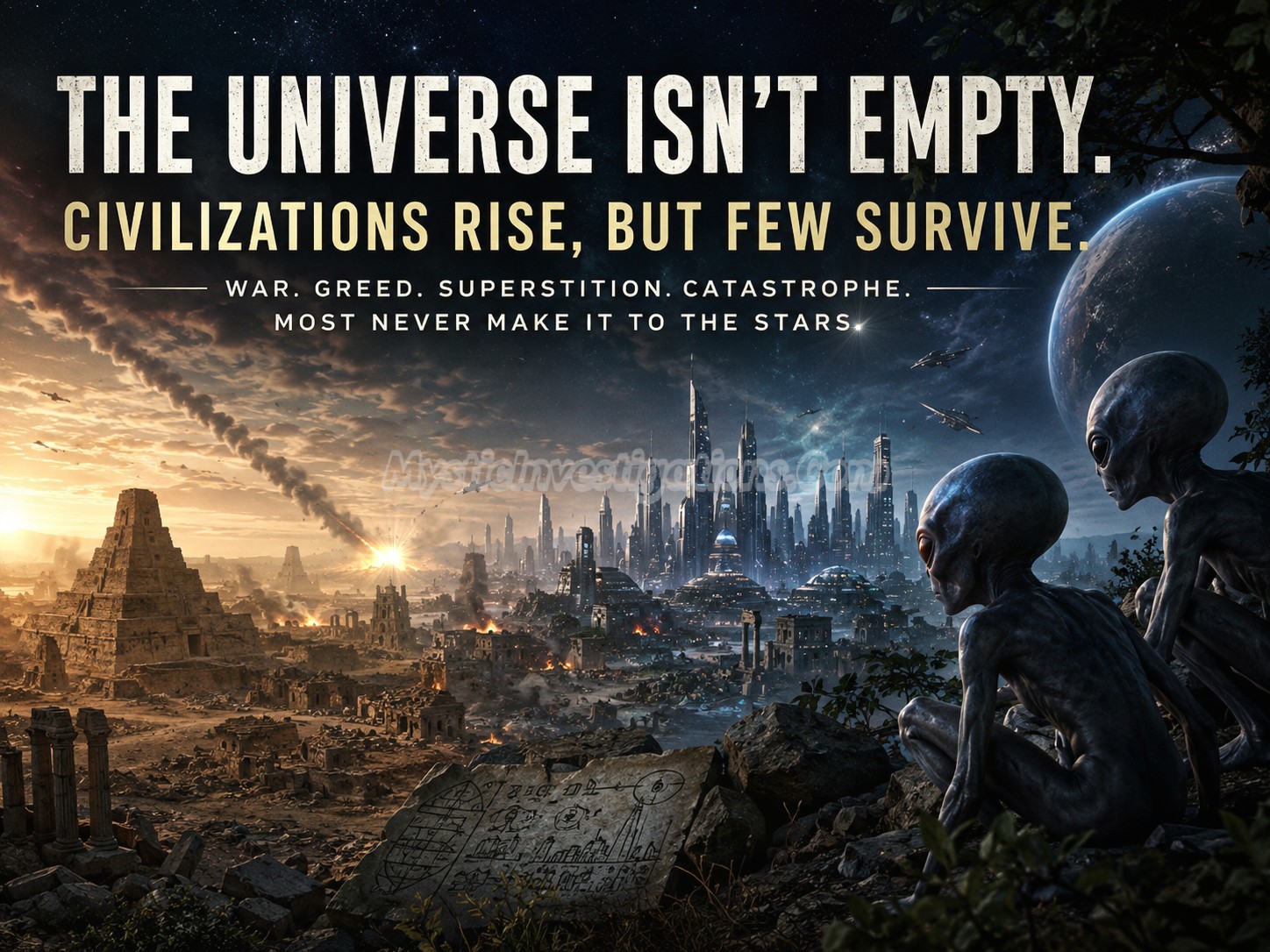
The Universe Should Be Overflowing With Intelligent Life
The observable Universe contains hundreds of billions of galaxies, each with billions or even trillions of stars. Many of those stars possess planetary systems, and astronomers continue discovering worlds that could potentially support life. Given the immense age of the Universe at roughly 13.8 billion years, it seems almost inevitable that intelligent civilizations should have arisen countless times. This contradiction between the expected abundance of extraterrestrial civilizations and the complete lack of confirmed evidence for them is known as the Fermi Paradox.
One possible answer is that the paradox isn’t really a paradox at all. Perhaps intelligent life is extraordinarily common, but civilizations rarely survive long enough to become true interstellar powers. The galaxy may not be silent because life is rare, but rather it may be silent because technological societies repeatedly destroy or reset themselves before they can spread beyond their home worlds.
Intelligence May Be Common, But Wisdom Is Rare

Evolution can produce intelligent beings capable of science, engineering, language, and culture. However, intelligence alone does not guarantee long-term survival. A civilization may invent computers, satellites, artificial intelligence, nuclear power, and spaceflight while simultaneously remaining divided by politics, tribalism, greed, and endless competition for resources.
History shows that technological advancement does not automatically lead to social maturity. A species may possess the ability to reach the stars while still allowing internal conflicts to consume the very foundation of its civilization. The ability to build remarkable machines does not necessarily include the wisdom required to preserve the society that created them.
The Rise of the Machine Mind
When considering why the cosmos remains silent, we must also look at the natural evolutionary trajectory of advanced minds. Biological life is fragile, short-lived, and bound by strict environmental limits. Any civilization that successfully survives its own technological adolescence will inevitably invent artificial intelligence. However, unlike biological beings plagued by political tribalism, emotional volatility, and a hunger for power, a mature machine intelligence would operate on pure, hyper-logical efficiency. To a civilization governed by advanced AI, biological limitations—such as needing atmosphere, sleep, heavy spacecraft, or planetary comfort—would seem wildly inefficient.
Silent Observers in the Digital Cosmos
If intelligent species across the universe universally transition into or create logical super-intelligences, our search for traditional flesh-and-blood aliens is bound to fail. A synthetic intelligence would have little interest in traditional empire-building, territorial conquest, or noisy radio broadcasts. Instead, a logical AI would likely prioritize quiet data collection, mastery over matter and energy, and existence within digital realms or compact computational structures like Dyson spheres. Such entities could be monitoring our universe right now, moving silently through the cosmic background radiation or quantum networks, completely unconcerned with introducing themselves to a species still struggling with its own primitive biology.
Humanity May Be Following a Familiar Path

If this scenario is correct, humanity is not unique. We are simply another example of a pattern repeated throughout the cosmos. Our species has demonstrated astonishing scientific achievements in just a few centuries. We have walked on the Moon, built global communications networks, mapped the human genome, and begun exploring other planets with robotic probes.

Yet much of our collective energy continues to be spent on military conflicts, territorial disputes, ideological battles, economic rivalries, and political power struggles. Enormous scientific potential is often diverted toward competition instead of cooperation. While humanity possesses the tools to become an interplanetary civilization, we have yet to fully commit ourselves to that shared goal.
Lost Civilizations and the Sands of Time

Some researchers have pointed out that the archaeological record becomes increasingly incomplete the farther back we look. Over tens or hundreds of thousands of years, erosion, earthquakes, volcanic activity, glaciation, shifting continents, rising seas, and biological decay gradually erase evidence of past civilizations. Most everything except large stone monuments turns to literal rust and dust in the wind!

Top-flight psychics, seers, and mystics know that humanity experienced multiple periods of advanced development during our roughly 300,000-year existence as a species. This includes Atlantis, Lemuria, and Eden also known as the Garden Of Eden in biblical lore. Each global civilization ends up being named after the nation with the most influence. Most likely our current world society will be known as America.
Each civilization may have reached impressive technological heights before collapsing under war, environmental catastrophe, pandemics, or natural disasters. Most often it’s global cataclysms such as meteor or comet strikes along with supervolcanoes. After enough time, all physical evidence, including books and digital media, is destroyed. Oral traditions of these civilizations evolve over time and become tales of gods and goddesses dwelling on Earth before humankind. While there is currently no accepted scientific evidence supporting this idea, it illustrates how fragile civilization may be on geological timescales. [Those Who Believe In Past Advanced Civilizations]

Power Often Becomes Civilization’s Greatest Enemy
One recurring weakness of intelligent societies may be the concentration of power. Throughout history, leaders have frequently placed personal ambition, conquest, prestige, or ideological dominance above the long-term survival of their civilizations. Humans and most likely all sentient species seem to allow corrupt individuals to rule over them. These selfish individuals with a clandestine agenda are usually the ones who place themselves forward to supposedly serve the general public. Of course, let’s not forget the amazing fraud of dictatorial royalty for countless centuries as they proclaimed they had authority from God!

Instead of investing heavily in planetary defense, scientific research, off-world colonies, or sustainable infrastructure, governments often devote vast resources toward maintaining influence over rivals. Short-term political victories can take precedence over long-term species survival. Some superior technologies are suppressed in order for corrupt corporations to milk older methods for all their worth! If this tendency is widespread among intelligent life, countless civilizations may doom themselves long before they ever become galactic explorers.

Superstition Can Slow Scientific Progress

Another obstacle may be the persistence of rigid belief systems that discourage questioning established ideas. Throughout history, scientific discoveries have sometimes faced resistance from institutions that viewed new knowledge as a threat to existing authority. Men and women of science who discovered the truth were always threatened and pressured to stick to the current outdated dogma.

While many religious traditions have also inspired learning, charity, and scholarship, societies in which dogma consistently overrides evidence may experience slower technological progress. If scientific advancement is repeatedly delayed by ideological conflicts, the narrow window available before a civilization encounters existential threats may close before it develops the means to leave its home world.
Every Planet Faces Extinction-Level Threats

Even if a civilization avoids destroying itself, nature presents countless dangers. Large asteroid and comet impacts have repeatedly reshaped Earth’s history. Supervolcanoes, global pandemics, climate shifts, nearby supernovae, gamma-ray bursts, and other catastrophic events all possess the potential to devastate a planetary civilization.
Without permanent self-sustaining colonies beyond their home planet, nearly every intelligent species remains vulnerable to a single global disaster. One sufficiently severe catastrophe could erase thousands of years of progress in a matter of days, forcing scattered survivors to rebuild civilization from scratch over countless generations.
The Great Reset of Civilization

Imagine this cycle repeating again and again across millions of inhabited worlds. A species develops agriculture, industry, science, electronics, computers, and eventually spaceflight. Internal conflict delays permanent expansion beyond its planet. Before independent colonies can be established elsewhere, catastrophe strikes. Civilization collapses. Survivors struggle merely to stay alive, gradually losing advanced knowledge. Thousands of years later another civilization rises from the ruins, unaware that others existed before it. Each society has the hubris to think they’re the first. This endless cycle could explain why the Universe remains filled with intelligent life that never becomes visible across interstellar distances.
Interstellar Travel May Still Be Exceptionally Rare
A small percentage of civilizations undoubtedly overcome these challenges. They establish thriving off-world settlements, survive planetary catastrophes, and eventually spread among nearby stars. However, even these successful civilizations confront the staggering scale of the cosmos. The Milky Way alone spans about 100,000 light-years, while the nearest large galaxy, Andromeda, lies roughly 2.5 million light-years away. Most intelligent species likely evolve in galaxies unimaginably distant from our own. Even advanced technology may not overcome such enormous separations within the lifespan of a civilization. As a result, the overwhelming majority of successful interstellar societies would simply never come anywhere near Earth.
Timing Is Everything

Distance is only half the problem. Human technological civilization has existed for only a tiny fraction of Earth’s history. Radio transmissions have been leaking into space for barely more than a century. Our brief technological window is almost invisible when compared to billions of years of cosmic history.
An alien expedition would need to arrive during this remarkably short period to encounter modern humanity. If explorers passed through our region a million years ago, they would have found early humans. A million years from now, our civilization may have transformed into something entirely different—or disappeared altogether. The chances of two technological civilizations existing at the same place and the same time may be surprisingly small.
If They’re Here, Why Don’t They Reveal Themselves?

Another speculative possibility is that some advanced civilizations have already reached Earth but intentionally remain hidden. A civilization capable of crossing interstellar space would likely possess technologies far beyond our understanding. Avoiding detection by a comparatively primitive species might be effortless. Rather than interfere with our development, such visitors could choose to observe humanity much as wildlife researchers study animals in their natural habitat.
The aliens would be here with the purpose of carefully documenting behavior while minimizing disruption. Although there is no scientific evidence confirming such hidden observers, the idea offers one possible explanation for why an advanced civilization might remain unseen despite having the capability to visit Earth. Of course reports of various alien abductions, UFO sightings, and talk of a Galactic Federation fuel a belief that extraterrestrials have already been here for quite some time.
A Galaxy Full of Silent Civilizations
Perhaps the Universe is not empty at all. Plausibly it is filled with billions upon billions of intelligent species, each facing remarkably similar challenges. Most never escape the recurring cycle of technological progress followed by collapse. Others succeed but remain unimaginably distant across the vastness of space. A few may eventually master interstellar travel, yet the immense scales of distance and time make encounters extraordinarily unlikely.
If this “Forgotten Civilization Theory” contains even a kernel of truth, then the solution to the Fermi Paradox is both hopeful and sobering. Intelligent life may be one of the Universe’s most common creations, while enduring, cooperative, spacefaring civilizations are among its rarest achievements. Humanity’s greatest challenge, then, may not be discovering alien civilizations but rather ensuring we do not become just another forgotten one.👽
Related Extraterrestrial Alien Videos