
The Popular Formula That Was Never Really Accurate
For decades, people have used the simple rule that one dog year equals seven human years. While easy to remember, this popular belief has never been scientifically accurate. Dogs do not age at a constant rate throughout their lives. Instead, they experience rapid growth and development during puppyhood before their aging gradually slows as adults.
The “seven-year rule” likely originated as a rough comparison between the average human lifespan and the average lifespan of dogs. Unfortunately, it ignores major differences in growth, maturity, breed, and body size. Thanks to decades of veterinary research and advances in genetics, scientists now have much more accurate methods for estimating a dog’s equivalent human age.
Dogs Mature Extremely Quickly
One of the biggest problems with multiplying by seven is that puppies become adults far sooner than human children. Most dogs reach sexual maturity before their first birthday and are physically mature by around two years old.
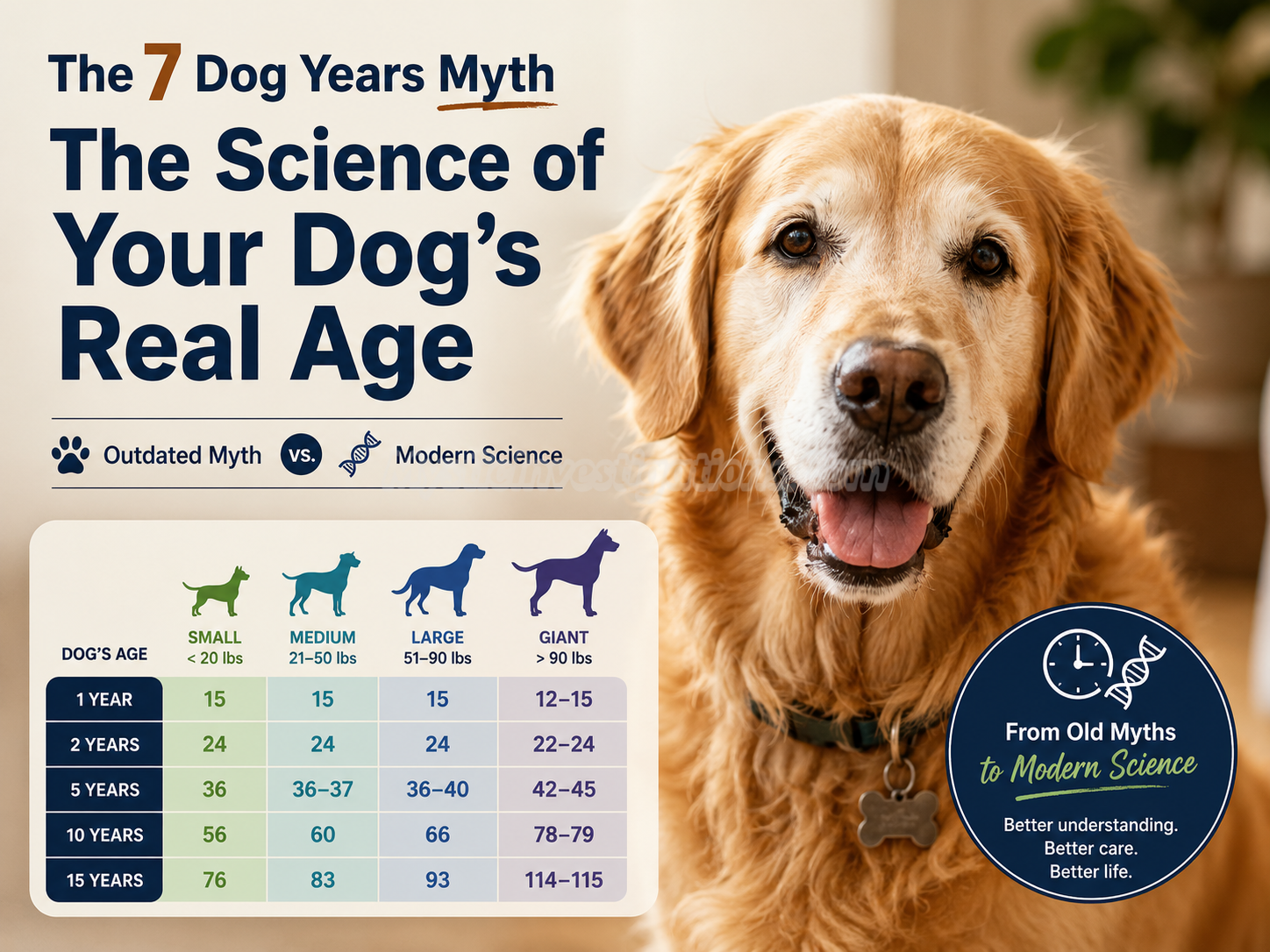
Under the old formula, a one-year-old dog would be only seven years old in human terms. In reality, veterinarians estimate that a one-year-old dog is closer to a 15-year-old teenager. By age two, most dogs are developmentally similar to a 24-year-old adult. After this point, aging becomes much more gradual.
This rapid early development explains why puppies can walk within weeks of birth, reproduce before turning one, and display adult behaviors long before they reach what the old formula would consider adulthood.
Why Dog Size Matters
Modern veterinary medicine has also shown that body size dramatically affects aging. Small breeds generally live much longer than giant breeds and therefore age more slowly throughout adulthood.
For example, a ten-year-old Chihuahua may still be energetic and healthy, while a ten-year-old Great Dane has often reached the equivalent of advanced old age. Scientists are still studying why this occurs, but larger dogs appear to experience faster biological aging and are more susceptible to age-related diseases earlier in life.
Because of these differences, veterinarians now use age charts that separate dogs into small, medium, large, and giant breeds rather than applying one formula to every dog.
The Veterinarian Method: The Practical Age Calculator
The method most veterinarians recommend today is based on decades of clinical observations of canine development, lifespan, and health. Rather than using a mathematical equation, it compares dogs of different sizes to humans based on typical stages of physical and biological aging.
Using this method:
| Dog Age | Small Dog | Medium Dog | Large Dog | Giant Dog |
|---|---|---|---|---|
| 1 year | 15 | 15 | 15 | 12–15 |
| 2 years | 24 | 24 | 24 | 22–24 |
| Every additional year | Add about 4–5 years | Add about 5 years | Add about 6 years | Add about 7–8 years |
These figures aren’t exact but provide an excellent estimate for everyday use. Veterinarians rely on these comparisons because they better reflect when dogs typically reach adolescence, middle age, and their senior years.
The UC San Diego Epigenetic Clock: Measuring Biological Age
In 2020, researchers at the University of California San Diego School of Medicine introduced an entirely different way to estimate a dog’s age. Instead of looking at behavior or lifespan, they examined the dog’s DNA itself.
The research focused on DNA methylation, an epigenetic process in which tiny chemical markers called methyl groups attach to DNA throughout an animal’s lifetime. These markers do not change the DNA sequence itself, but they influence how genes are turned on and off. Scientists have discovered that methylation patterns change in highly predictable ways as mammals grow older, making them one of the most reliable biological indicators of aging.
Because these methylation patterns act almost like a molecular clock, researchers can estimate an organism’s biological age, which may differ from its chronological age.
Comparing Dog DNA to Human DNA
The UC San Diego researchers compared DNA methylation changes in Labrador Retrievers with equivalent changes in humans. Their goal was not simply to convert dog birthdays into human birthdays but to determine when similar biological aging events occur in both species.
Their analysis revealed that dogs experience an explosive burst of biological aging early in life before the pace slows considerably. This closely matches what veterinarians have observed for decades but provides genetic evidence to explain why it happens.
Using their research, they developed the following equation:
Human Age = 16 × ln(Dog Age) + 31
In this equation, ln stands for the natural logarithm, a mathematical function that describes growth that is rapid at first and then gradually slows over time.
Unlike the old “multiply by seven” rule, the logarithmic formula produces a curved aging pattern rather than a straight line.
Understanding the Formula
The logarithmic equation can produce surprising results. According to the model:
- A 1-year-old dog equals approximately 31 human years
- A 2-year-old dog equals approximately 42 human years
- A 5-year-old dog equals approximately 57 human years
- A 10-year-old dog equals approximately 68 human years
At first glance, these estimates seem much older than those used by veterinarians. However, this is because the formula is measuring cellular biological aging, not behavioral or developmental milestones.
A one-year-old Labrador may possess DNA that resembles that of a 31-year-old human, even though its physical maturity and behavior are more comparable to a human teenager.
Why the Two Methods Give Different Answers
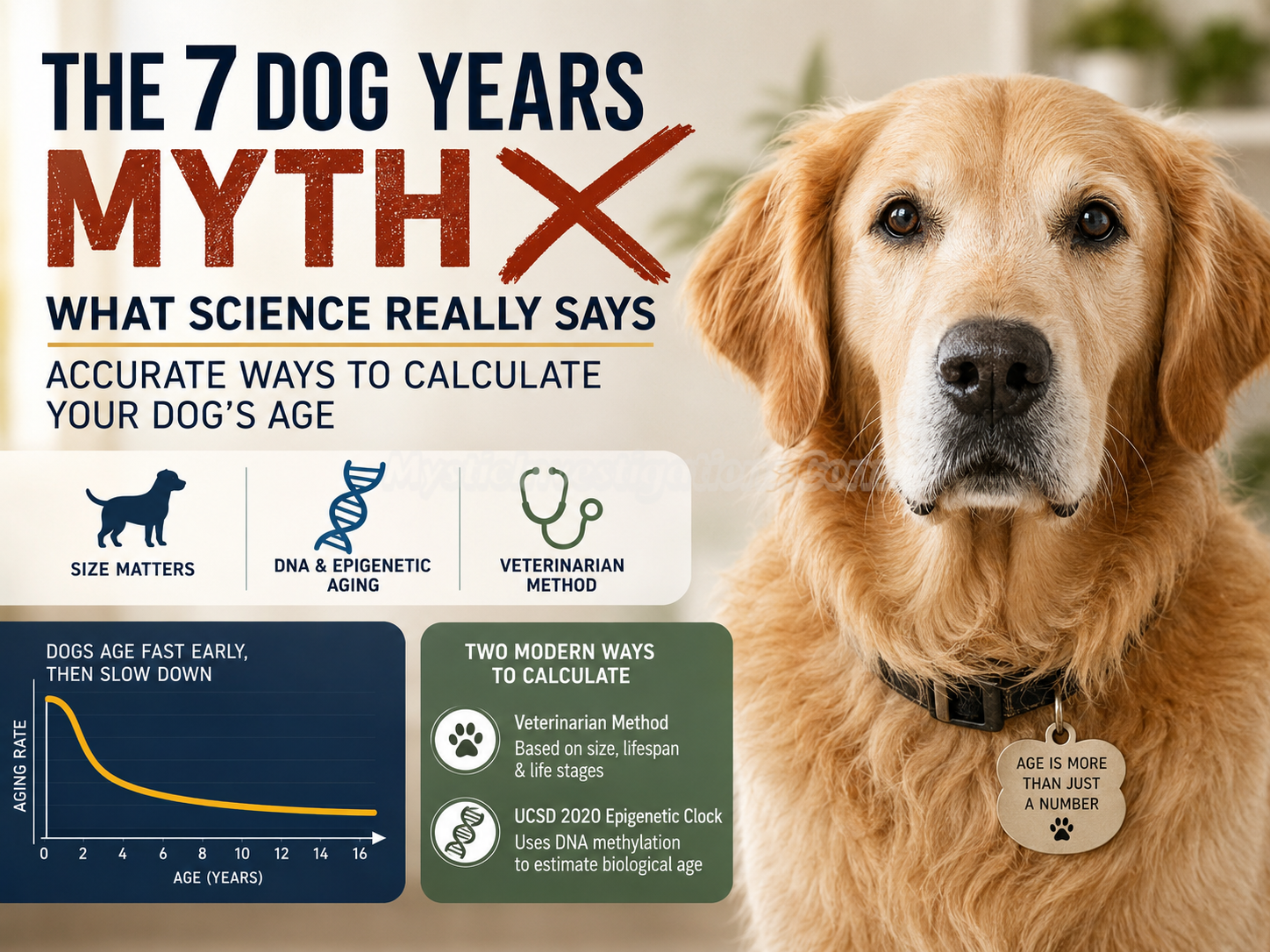
The veterinarian method and the UCSD epigenetic clock are often confused because they answer different scientific questions.
The veterinary method estimates functional age. It asks, “What stage of life is this dog in compared to a human?” This makes it useful for determining nutrition, exercise needs, preventive care, and when a dog should be considered a senior.
The UCSD epigenetic clock estimates biological age at the cellular level. It asks, “How old do this dog’s cells appear compared to human cells?” It is designed primarily for genetics research, aging studies, and evaluating treatments that may slow the biological aging process.
Neither method is wrong—they simply measure different aspects of aging.
Which Method Should Dog Owners Use?
For most pet owners, veterinarians recommend using the modern size-based age charts. They are easier to understand, account for differences between breeds, and more accurately reflect a dog’s developmental stage and healthcare needs.
The UC San Diego epigenetic clock remains one of the most fascinating breakthroughs in aging research because it demonstrates that the “seven dog years” myth was never biologically correct. As scientists continue studying canine genetics, future age calculators may combine DNA analysis, breed characteristics, body size, and health history to produce even more personalized estimates of a dog’s true biological age.
Today, one thing is certain: your dog’s age is far more complex than simply multiplying by seven, and modern science is giving us an increasingly accurate understanding of how our faithful companions grow older.🐕