What Is Mischief Night?
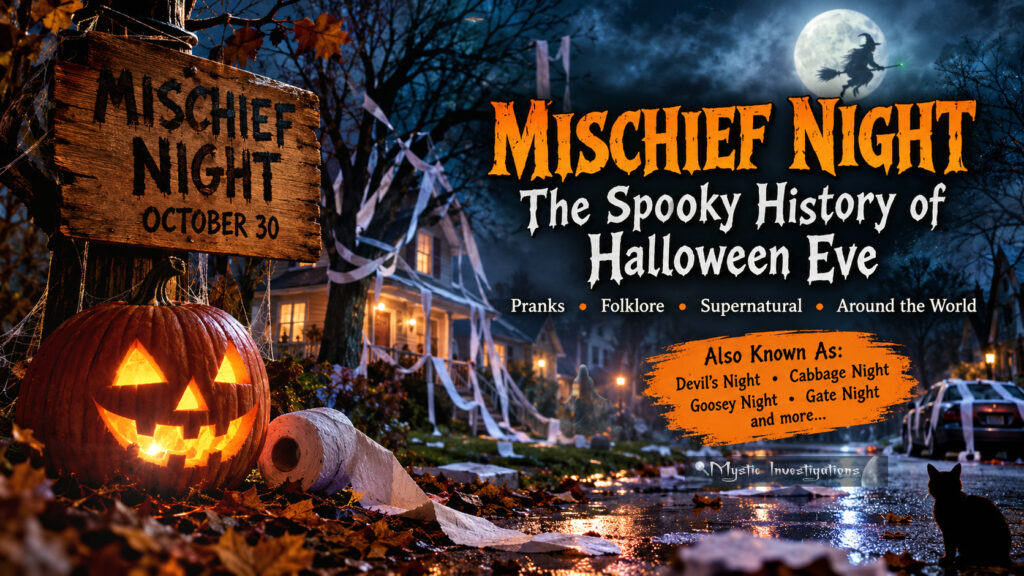
October 30th is more than just the night before Halloween in certain parts of the world. It is an unofficial holiday devoted to pranks, mischief, misbehavior, and sometimes downright supernatural mischief! Known primarily as Mischief Night, this peculiar tradition gives children, teenagers, and occasionally mischievous adults an opportunity to engage in harmless tricks before the main Halloween festivities begin. Common activities include throwing toilet paper over trees, covering cars and houses with shaving cream, soaping windows, ringing doorbells, and running away, and occasionally tossing eggs at unsuspecting homes. However, the tradition has a considerably darker history in certain communities. Some believe the evening’s association with mischief is particularly appropriate because it falls during the Halloween Season, when supernatural forces are traditionally believed to become more active.
The Ancient Supernatural Connection
Although the modern version of Mischief Night is relatively recent, its atmosphere has much older connections to European seasonal folklore. The ancient Celtic festival of Samhain marked the transition from the harvest season into winter. It was believed to be a time when the boundary separating the physical world from the supernatural realm became unusually thin. Spirits of the deceased, mischievous fairies, and other supernatural entities were thought to have greater freedom to interact with humanity. People traditionally used bonfires, protective customs, disguises, and offerings to navigate this spiritually dangerous period. While Mischief Night itself cannot be directly traced to an ancient Celtic ceremony, its modern placement immediately before Halloween puts it within a season long associated with paranormal activity.
Perhaps the pranksters of today are unknowingly continuing an ancient tradition of inviting chaos into the darkness! The Spirit Of Halloween can compel humans to actively participate in celebrating the sainted season of Samhain. Ultimately, Halloween is about achieving an annual balance between the righteous force of light and diabolical darkness. Something essential to the survival of Earth and the greater Universe at large. Having a more malicious night before the night of fun-filled trick or treating appears to be a part of that enchanted equation.
The British Origins of Mischief Night
The expression “Mischief Night” actually has documented British origins dating back centuries. One of its earliest recorded appearances was in Oxford in 1790, although the tradition itself was older. Interestingly, the original Mischief Night wasn’t necessarily associated with Halloween. In parts of England, it was traditionally observed on April 30th before May Day or Beltane, when young people celebrated the arrival of spring with practical jokes. These activities included moving objects, switching signs, overturning containers, and generally creating confusion throughout their communities. By the 19th century, Mischief Night was also associated with the evening before Guy Fawkes Night on November 5th. In some northern English communities, the tradition eventually became associated with October 30th. The idea of having an evening when ordinary rules were temporarily turned upside down proved remarkably enduring.

England’s Strange Tradition of Moving Gates
In northern England, particularly Yorkshire, Mischief Night developed a reputation for elaborate practical jokes. Young pranksters sometimes removed gates from their hinges and relocated them to unexpected places. Garden furniture, farm equipment, and other household belongings could mysteriously disappear overnight, only to turn up somewhere completely different. This became particularly associated with the November 4th observance preceding Guy Fawkes Night in certain communities. Some people considered these activities harmless entertainment, while homeowners who discovered their property missing probably had a different opinion! From a supernatural perspective, there is something particularly intriguing about a night when familiar objects are displaced and the ordinary order of things is deliberately disrupted. In traditional folklore, mischievous fairies and supernatural tricksters were notorious for doing precisely the same thing.
Devil’s Night: Detroit’s Dark Halloween Eve
Perhaps the most infamous alternative name for Mischief Night is Devil’s Night, particularly in Detroit, Michigan. October 30th became associated with this name as neighborhood pranks evolved into increasingly destructive activities. During the 1970s and 1980s, Detroit experienced serious vandalism and widespread arson around Halloween. It was almost like The Purge! The situation reached an alarming point in 1984, when more than 800 fires were reported across the city during the three days surrounding Halloween. Abandoned buildings, vehicles, and other structures became targets. The terrifying nickname Devil’s Night seemed particularly appropriate as flames illuminated the darkness and smoke filled the autumn skies. Authorities eventually introduced curfews and organized neighborhood patrols to combat the destruction. In 1995, Detroit introduced a large-scale volunteer initiative called Angels’ Night, turning the traditionally ominous evening into an opportunity for community protection. The transformation from Devil’s Night to Angels’ Night almost sounds like a supernatural battle between opposing forces!

Cabbage Night: When Vegetables Become Weapons
Another unusual name for Halloween Eve is Cabbage Night, traditionally associated with parts of the northeastern United States, New England, and certain Great Lakes communities. The name has historical connections to the practice of throwing cabbages and other vegetables during Halloween-related mischief. A newspaper reference from Trenton, New Jersey, in 1861 specifically described boys carrying cabbages during an evening associated with Halloween celebrations. Rotten vegetables could become unpleasant projectiles, while cabbage leaves and other garden debris might be scattered across properties. Although the precise customs varied between communities, the name demonstrates how agricultural traditions became incorporated into Halloween mischief. One might imagine supernatural goblins and garden-dwelling imps joining the festivities, gleefully launching enchanted cabbages at unsuspecting mortals!

Goosey Night: A Mysterious Regional Name
In parts of northern New Jersey and the New York metropolitan area, October 30th has also been known as Goosey Night. Unlike Cabbage Night, the exact origin of this peculiar name remains uncertain. Some linguistic theories connect the expression with the idea of foolish or silly behavior, while other explanations suggest connections to disguises and older nighttime customs. Goosey Night was traditionally associated with youthful pranks, including egg throwing, pumpkin smashing, and other forms of neighborhood mischief. The name itself has an almost comical quality, but the activities sometimes became considerably less amusing for property owners. It is also a reminder that local folklore frequently develops its own vocabulary, with neighboring communities sometimes giving the same unusual evening completely different names.

Other Names for Halloween Eve
Mischief Night has accumulated a surprisingly large collection of regional names throughout North America and Britain. Some of the alternatives include:
- Devil’s Night: Particularly associated with Detroit and southeastern Michigan.
- Cabbage Night: Found in parts of New England, the northeastern United States, and the Great Lakes region.
- Goosey Night: Traditionally associated with northern New Jersey and parts of the New York metropolitan area.
- Gate Night: Associated with communities where pranksters traditionally removed gates and relocated them.
- Hell Night: A particularly ominous name used in certain American communities.
- Trick Night: A straightforward description of the evening’s practical jokes.
- Chalk Night: Associated with the practice of writing or drawing on sidewalks, buildings, and other surfaces with chalk.
- Corn Night: Connected with the historical practice of throwing corn at people or properties.
- Moving Night: Refers to the tradition of relocating outdoor furniture and other belongings.
- Doorbell Night: Named after the familiar prank of ringing doorbells and disappearing before anyone answers.
- Mizzy Night: A British regional variation of Mischief Night, particularly associated with Liverpool.
There are also scattered references to names such as Damage Night, Fox Night, Soap Night, and Ticktack Night. The names vary considerably depending on local customs and historical traditions.
Mischief Night in Scotland and Ireland
Scotland and Ireland have their own fascinating histories of Halloween mischief. Traditional Scottish Halloween celebrations included guising, in which people dressed in costumes and traveled between homes performing songs, jokes, or other entertainment in exchange for treats. Scottish Halloween folklore also featured supernatural beings, including fairies, witches, and spirits believed to be particularly active during the changing seasons. Ireland, meanwhile, has deep connections to Samhain, the ancient festival that helped shape modern Halloween. Traditional activities included bonfires, fortune-telling, disguises, and customs intended to protect households against supernatural visitors. Although neither country has one universally observed equivalent of American Mischief Night, the older customs demonstrate that Halloween-related mischief and supernatural encounters have long been intertwined throughout the British Isles.

Mischief Night in Canada
Canadian communities have inherited several Halloween Eve customs from their British, Irish, and American cultural influences. In some locations, Mischief Night is recognized on October 30th, with activities similar to those found in the northeastern United States. Quebec has also been associated with the expression Mat Night, referring to the practice of moving or switching people’s outdoor doormats. Imagine stepping outside on Halloween morning only to discover that your welcome mat has mysteriously relocated to a neighbor’s front porch! These traditions demonstrate how mischievous behavior can become an established part of local community folklore. Canada also has its own rich Halloween traditions involving ghost stories, haunted locations, and supernatural legends, making the evening a natural extension of the country’s spooky autumn celebrations.

The Supernatural Tricksters Behind the Mischief
Throughout world folklore, supernatural tricksters have been blamed for activities remarkably similar to those associated with Mischief Night. European fairies were notorious for hiding household objects, confusing travelers, moving possessions, and playing tricks on unsuspecting humans. Goblins and imps were frequently portrayed as troublesome little creatures that delighted in creating chaos. In Germanic folklore, kobolds were associated with household disturbances, while other supernatural beings were believed to interfere with ordinary human activities. Some traditions even suggested that unexplained noises, misplaced objects, and mysterious disturbances were evidence of supernatural visitors. Could some of the activities associated with Mischief Night have originally been inspired by stories of these supernatural pranksters? While there is no historical evidence establishing such a connection, the similarities are certainly entertaining to contemplate. Perhaps the human pranksters are simply imitating the legendary behavior of creatures that supposedly have been playing tricks on humanity for centuries!

The Connection Between Mischief Night and the Spirit World
October 30th occupies an interesting position within the traditional Halloween calendar. It arrives just before October 31st, which is followed by November 1st, All Saints’ Day, and November 2nd, All Souls’ Day. These observances have historical religious and folkloric connections to remembering the deceased. Older European traditions also associated this seasonal period with wandering spirits and supernatural visitors. In some historical interpretations, Halloween’s proximity to these observances helped reinforce its reputation as a time when the living and dead were unusually close. Mischief Night adds another layer of chaos to this already mysterious period. From a paranormal investigator’s perspective, it is an interesting question whether the heightened atmosphere of nighttime pranks, fear, and anticipation contributes to the number of reported strange experiences during the Halloween season. Even without supernatural involvement, the combination of darkness, unusual noises, and heightened expectations can make October 30th feel genuinely otherworldly.

When Mischief Night Goes Too Far
Although Mischief Night has traditionally been associated with harmless entertainment, its darker history demonstrates how quickly mischief can become dangerous. Egging someone’s house, damaging pumpkins, destroying property, setting fires, or endangering motorists are not harmless pranks. Detroit’s Devil’s Night history is a particularly sobering example of what happens when an evening of youthful misbehavior becomes associated with serious criminal activity. Many communities now encourage supervised Halloween activities, neighborhood celebrations, and volunteer patrols to discourage vandalism. The supernatural world might be full of mischievous entities, but that doesn’t mean humans should imitate their worst behavior! A good Mischief Night should involve laughter, harmless surprises, and spooky entertainment rather than frightened neighbors and damaged property.
Bringing Back the Spirit of Harmless Mischief
There is no reason Mischief Night cannot be celebrated in the playful spirit of its original traditions. Families and friends can organize harmless pranks, Halloween scavenger hunts, spooky treasure hunts, costume contests, and supernatural storytelling competitions. Neighbors might decorate one another’s porches with unexpected Halloween surprises or leave mysterious Halloween messages for friends to discover. Haunted-house visits and nighttime ghost tours are also excellent ways to embrace the darker atmosphere of October 30th. The objective should be to create a little harmless chaos and excitement before Halloween arrives. After all, Halloween is traditionally about tricks and treats, and Mischief Night provides an opportunity to enjoy the tricks before the candy-filled festivities begin!
The Mysterious Night Before Halloween
Mischief Night remains one of Halloween’s strangest and least universally recognized traditions. Some communities celebrate it enthusiastically, others know it by completely different names, and many people have never heard of it at all. Its history stretches from British springtime pranks to American Halloween vandalism, with regional traditions involving cabbages, missing gates, relocated furniture, and doorbell-ringing troublemakers. Its association with Devil’s Night also gives it a particularly sinister reputation in certain locations. Yet beneath the jokes and neighborhood disturbances lies a fascinating connection to centuries of seasonal folklore involving supernatural tricksters, wandering spirits, and the mysterious transition into winter. Whether you call it Mischief Night, Devil’s Night, Cabbage Night, or Goosey Night, October 30th is an unusual opportunity to embrace the mischievous spirit of Halloween. Just remember to keep your eyes open after dark. You never know whether that mysterious noise outside your window is a neighborhood prankster, a mischievous supernatural entity, or something considerably more sinister!🎃
Halloween Historical References
These sources provide additional historical background on Halloween Eve:
- Smithsonian Institution – What Do You Call the Night Before Halloween?
- Detroit Historical Society – Haunted History: Devil’s Night
- Cumberland County Historical Society – Mischief Night
- Wordorigins – Mischief Night and Other Names