A Search for Safer Refrigeration
The story of Teflon and forever chemicals begins in the early twentieth century, when scientists were searching for safer refrigeration technologies. Early refrigerators often relied on toxic or flammable gases. Leaks could lead to poisoning, fires, or explosions. Chemical companies sought a safer alternative that would eliminate these dangers while maintaining efficient cooling systems.🧊
An Accidental Discovery
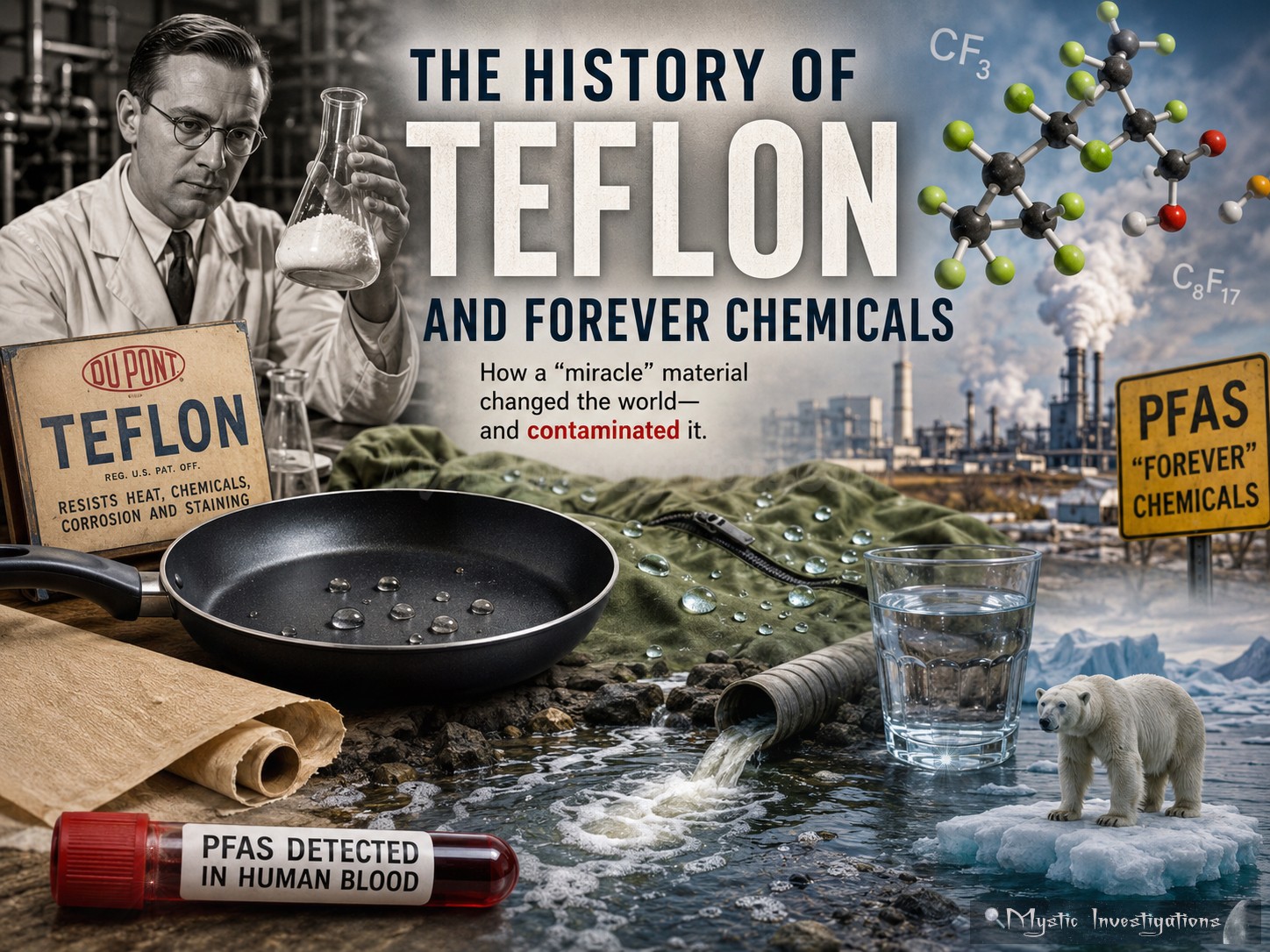
In 1938, a young chemist named Roy J. Plunkett was working for DuPont and experimenting with a gas called tetrafluoroethylene. During one experiment, a pressurized cylinder appeared empty even though it still weighed as much as a full container. After cutting open the cylinder, Plunkett discovered a strange white powder inside. The gas had unexpectedly transformed into a new material known as polytetrafluoroethylene, or PTFE.
The Birth of Teflon
Further testing revealed that PTFE possessed remarkable properties. Water rolled off its surface, acids could not corrode it, and most chemicals failed to react with it. The material was exceptionally slippery and resistant to heat. Recognizing its commercial potential, DuPont eventually trademarked the material under the name Teflon in 1944.
The Power of the Carbon-Fluorine Bond
Teflon’s extraordinary durability comes from the carbon-fluorine bond. This bond is one of the strongest found in organic chemistry. Fluorine atoms cling tightly to carbon atoms, creating a highly stable molecular structure. As a result, Teflon resists chemical attack, heat, moisture, and degradation better than almost any material previously known.🧪

Teflon and World War II
During World War II, Teflon became strategically important to the United States military. Scientists working on the Manhattan Project needed materials that could withstand highly corrosive chemicals used in uranium processing. Teflon proved nearly indestructible under these conditions and was used in seals, gaskets, pipes, and other critical components involved in the development of nuclear technology.
Solving Manufacturing Challenges
Although Teflon itself was revolutionary, producing it on a large scale was difficult. The manufacturing process generated significant heat and carried the risk of explosions. To solve this problem, DuPont began using a chemical called perfluorooctanoic acid, or PFOA. Internally, the company often referred to this chemical as C8. PFOA allowed Teflon production to be conducted more safely and efficiently.
The Consumer Revolution
After the war, Teflon entered the consumer marketplace. One of its most famous uses was in non-stick cookware. Introduced commercially during the 1950s, Teflon-coated frying pans transformed cooking by preventing food from sticking to surfaces. Consumers quickly embraced the convenience, and Teflon became a household name.🍳
Teflon Everywhere
The success of Teflon extended far beyond cookware. The material found its way into stain-resistant carpets, waterproof clothing, medical implants, industrial machinery, aerospace equipment, and countless other products. Related fluorinated chemicals were used to create coatings that repelled water, grease, and dirt, making them highly attractive for commercial applications.
The Rise of PFOA
While Teflon itself is generally considered relatively inert, the chemicals used during its production presented a different story. PFOA became one of the most important processing aids in the fluorochemical industry. Unlike Teflon’s large polymer chains, PFOA molecules were small enough to enter living organisms and persist in the environment.

Early Warning Signs
Internal studies conducted by chemical companies during the 1960s reportedly revealed troubling evidence. Laboratory animals exposed to PFOA developed enlarged livers and other health problems. Further studies suggested toxic effects in multiple organs and species. Yet much of this information remained largely unknown to the public for decades.
Discovery in Human Blood
In the 1970s, researchers studying fluoride levels in human blood discovered something unexpected. They found organic fluorine compounds in people across the United States. Further analysis suggested these chemicals were linked to industrial fluorinated compounds such as PFOA. The findings indicated that contamination had spread far beyond factory workers.🩸
Pollution Around Parkersburg
One of the most famous contamination cases emerged near Parkersburg, West Virginia, home to DuPont’s Washington Works facility. Local farmer Earl Tennant noticed mysterious illnesses and deaths among his cattle. Investigations eventually pointed toward contamination originating from a landfill associated with the plant. The case would become one of the most significant environmental legal battles in American history.
A Legal Battle Uncovers Evidence
Attorney Robert Bilott took on the case and gained access to thousands of internal corporate documents. His investigation revealed extensive evidence of PFOA use and environmental releases. The documents suggested that company officials had long been aware of concerns regarding the chemical’s persistence and potential health risks.
Human Health Concerns Emerge
Subsequent scientific studies linked elevated PFOA exposure to a variety of health conditions. Research identified probable associations with kidney cancer, testicular cancer, thyroid disease, ulcerative colitis, elevated cholesterol levels, and pregnancy-related complications. While researchers continue to investigate the exact biological mechanisms, concern about long-term exposure has grown substantially.💉
From PFOA to PFAS
PFOA is only one member of a much larger family known as PFAS, short for per- and polyfluoroalkyl substances. Scientists estimate that thousands of PFAS compounds exist. Many share the same highly durable carbon-fluorine chemistry that makes them useful in products but also difficult to remove from the environment.
Why They Are Called Forever Chemicals
PFAS are often referred to as “forever chemicals” because they break down extremely slowly. Many can remain in soil, water, wildlife, and human bodies for years or even decades. Their persistence allows them to travel long distances through air and water systems, leading to contamination in places far removed from their original sources.
A Global Contamination Problem
Today, PFAS contamination has been detected on every continent, including Antarctica. Scientists have found these chemicals in rivers, lakes, oceans, rainwater, wildlife, and human blood. Studies suggest that the vast majority of people carry measurable amounts of PFAS in their bodies. The chemicals have been detected in polar bears, fish, birds, and numerous other species, demonstrating the global scale of the problem.🌎

New Chemicals, Familiar Questions
As regulatory pressure increased, manufacturers began replacing older compounds such as PFOA with newer alternatives. However, concerns remain that some replacement chemicals may present similar environmental and health challenges. Critics argue that replacing one PFAS compound with another often creates a cycle in which regulators and scientists struggle to keep pace with industry innovation.
Government Regulation and Public Awareness
In recent years, governments around the world have begun implementing stricter regulations for PFAS in drinking water and consumer products. Improved testing methods have revealed contamination levels far lower than scientists could reliably detect decades ago. Public awareness has also increased as documentaries, lawsuits, scientific reports, and news investigations have brought attention to the issue.
Protecting Yourself from PFAS Exposure
Although completely avoiding PFAS is nearly impossible, there are practical steps people can take to reduce exposure. Using certified water filtration systems such as reverse osmosis or activated carbon filters can help remove many PFAS from drinking water. Reducing consumption of microwave popcorn and fast food packaged in grease-resistant wrappers may also lower exposure. Choosing PFAS-free personal care products and household items can further reduce contact with these chemicals.
Staying Healthy in a Contaminated World
Experts emphasize that PFAS exposure is only one factor influencing overall health. Maintaining a healthy diet, exercising regularly, avoiding smoking, getting adequate sleep, and following routine medical care remain among the most important ways to reduce disease risk. While scientists continue developing better filtration systems, safer alternatives, and improved regulations, informed consumers can make choices that minimize exposure. The story of Teflon and PFAS serves as a powerful reminder that technological breakthroughs can bring tremendous benefits, but understanding their long-term consequences is equally important for protecting both human health and the environment.⚗️
Related Videos